2026 Edition · Every price, spec and regulation carries the day it was checked
Fourteen Prospectors Said They Were Losing Gold. One Had Measured.
That count is from the forum threads and comment sections read for this book, and it is the whole reason it exists. The Second Pan is 384 pages of arithmetic you can redo: measure what your own box is handing back to the river with a second bucket and nothing else, read what a machine's own maker says it needs before you own it, and price a bag of paydirt against the seller's own published grams before you type a card number. Every price, specification and regulation in it carries the day it was checked.
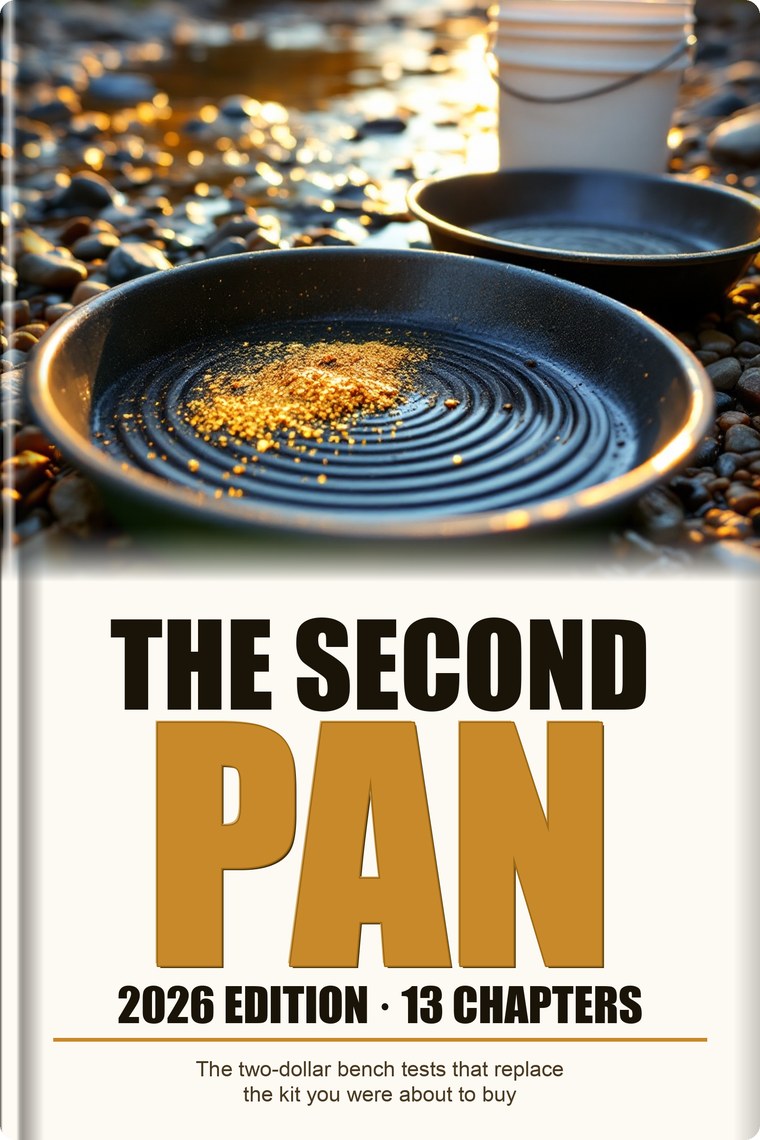
One PDF. 384 pages. Thirteen chapters. The Receipt Log workbook bundled in the same file.
The Second Pan — 2026 Edition
$27
One PDF · 384 pages · 13 chapters · The Receipt Log included in the same file
Nothing on them is new — every figure comes from the book, from the chapter named beside it. You are paying for a sheet you can hold in the rain. Sixty-day refund, and you keep the PDF.
Secure Stripe checkout · Instant PDF delivery to your email
Sixty-day refund, and you keep the PDF
There is no sentence in this book that says you will find more gold. What it says is narrower and it is deliverable: you will stop paying for things that were never going to help you, and you will be holding measurements where you used to be holding opinions.
Free · One PDF · 28 pages
The Jar on the Shelf
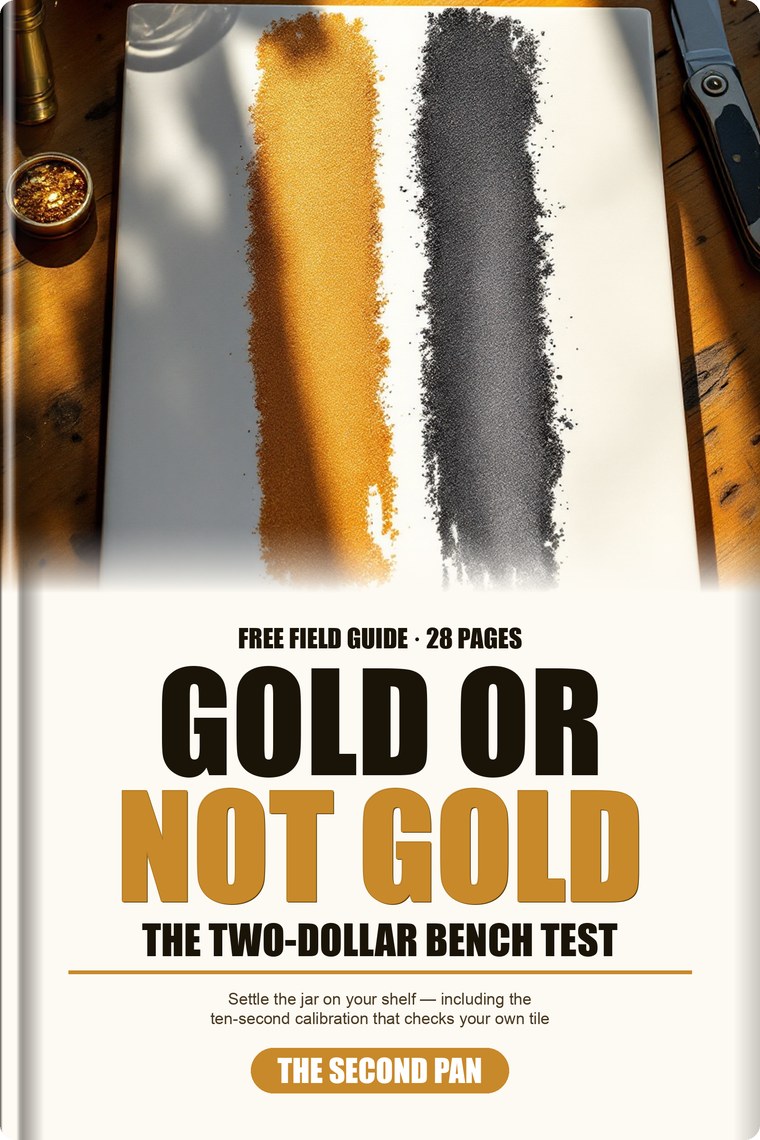
Somewhere in your house there is a vial, a film canister or a pill bottle with something in it that might be gold. It has been there for years, because you were never sure and you stopped wanting to ask.
Gold or Not Gold settles it tonight, on your kitchen bench, on material you already have. The one thing you may not have is an identified lump of pyrite, and the file says so on its own list — without one it tells you not to improvise, and prints what the specified porcelain plate cost, with the vendor and the day it was checked. It is 28 pages and it is free.
- The ten-second calibration, and it comes first. Before you trust a tile, you calibrate it — against a quartz pebble, a piece of glass, and a lump of pyrite. Because a tile too soft to streak pyrite does not fail safe: it plows a groove of pale tile dust and fails toward a false positive. The weakness of the trick comes before the trick, on purpose.
- The streak itself. The color of the powder is not the color of the lump, and that is the whole trick.
- The knife point, the shade test, the angle test, and what it does in water. All free — the knife point out of published mineralogy, the two eyeball tests out of what prospectors actually report, printed with the disagreement between them left in.
- The magnet correction. A magnet tells you what is magnetite and nothing whatever about pyrite, because pyrite is essentially non-magnetic too. The most repeated test in this hobby answers a question nobody asked. If you checked with a magnet, you cleaned your sample. You did not test it.
- The arithmetic that kills the density test. A one-gram nugget displaces about 0.052 g of water — half of one division on a 0.1 g kitchen scale. The formula is printed so you can redo it and see for yourself where the threshold actually sits.
Where this file stops, stated as plainly as it teaches. A streak needs a particle you can hold between finger and thumb and drag, so this is a test for pickers and chunks and it does nothing for flour gold. A streak plate and an acid kit are not the same instrument: acid answers how pure, streak answers gold or not gold.
And it will not tell you where gold is, what your piece is worth, or how much of it your sluice is handing back to the river. It answers one question and then it stops.
Free. One PDF, 28 pages. No card, and you can leave the list from any email in one click.
You will also get three emails over the next nine days about what the book does. If they are not for you, the unsubscribe link is at the bottom of every one and nothing else happens.
You will know whether that picker is gold. You will still have no idea how many of its brothers went out of the back of your sluice the last time you ran one, or whether the machine you bought to catch them would fix it. That is the book.
Four Kinds of Sentence. There Is No Fifth.
Every claim in these 384 pages is one of exactly four things, and anything that was none of them did not go in.
01
A published price
With the vendor named and the day it was checked.
02
A specification the manufacturer published about their own product
Quoted, with the page it came from.
03
Physics or arithmetic you can reproduce
With the formula printed, so you can redo it with today's number.
04
A regulation cited by section
With the day it was checked and the instruction to check it again.
No brand is ranked here. No company is accused of anything. No test result is reported that somebody else did not publish first. And nobody here claims to have stood in your creek.
Secure Stripe checkout · Instant PDF delivery to your email · Sixty-day refund, and you keep the PDF
Almost Nobody in This Hobby Measures. Almost Everybody Buys.
Read enough threads and the shape of it is hard to miss. Fourteen prospectors said they were losing fine gold out of the back of the box. Three said they were afraid of it without knowing. Five said the fear is overblown. And one man had actually re-run a full day of his own tailings and come back with a result.
That is the count from the threads and comment sections read for this book, and it is not a survey. It is still the whole problem. On one side of that argument sit machines listed at $84.95 to $460.00 by their retailers on 26 August 2026, and on the other side sits a second bucket.
The one man who measured expected a fortune in his tailings. He found three flakes. That result is not the point. The fact that he knows is the point — and he is the only person in that entire argument who was not guessing.
This book is not written against the machines. All three of the purchases it does recommend cost money, and Chapter 12 is a chapter about the place where the cheap answer is the wrong one. It is written against buying a fix for a problem you have never put a number on.
Secure Stripe checkout · Instant PDF delivery to your email · Sixty-day refund, and you keep the PDF
Six Places This Hobby Takes Your Money Without Anyone Doing the Division
Each one is a chapter. Each chapter tells you what it decides before you read it.
01
The Hour Nobody Divides
You know what the gear cost, near enough. You know roughly what is in the vial. You have never put those two numbers on the same sheet of paper, and neither has anybody you have asked.
A prospector opened a thread asking whether this equipment ever pays for itself. It ran past twenty replies. There is not one calculation in it.
Chapter 1 — What Your Gram Is Worth, and What Your Hour Costs. Turns any published gold price into what your gold is worth, with the purity left as a blank you fill in rather than a figure somebody guessed on your behalf — because the published fineness of American placer gold runs across a wide band, and the discount to spot is anywhere from a couple of percent to about thirty depending on where it came from. Then the hour sheet. Every purchase priced in the rest of the book gets divided by one of those two numbers, which is why this chapter goes first. The Receipt Log, bundled free in the same file, is where a season of it becomes your cost per hour and your cost per gram.
02
The Half You Might Be Giving Back
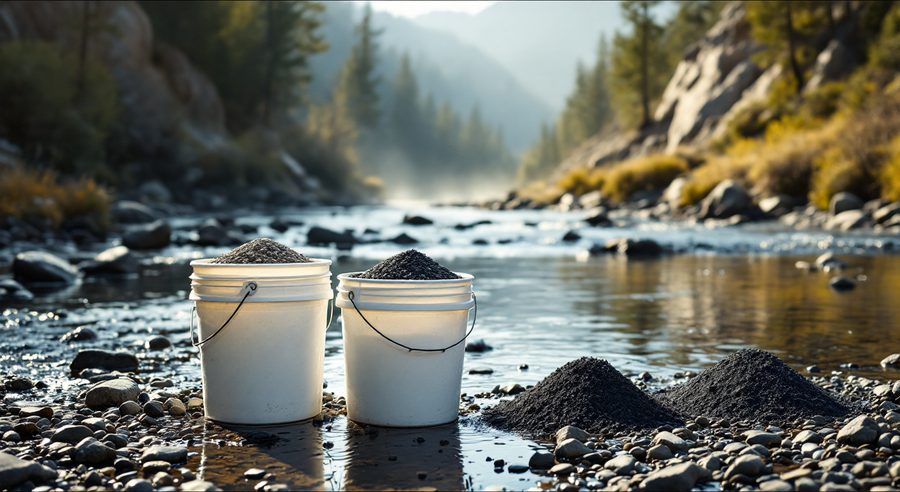
"I'm going out to find gold not give half of it back." A stranger on a forum wrote that, and you have had the same thought standing over the bottom end of your box. So you started pricing mats.
Nobody can tell you what you are losing, and you should be suspicious of anyone who does. Five serious published sources speak to where sluice recovery falls away and they land in five different places. Not one of them measured your box, in your water, on your material.
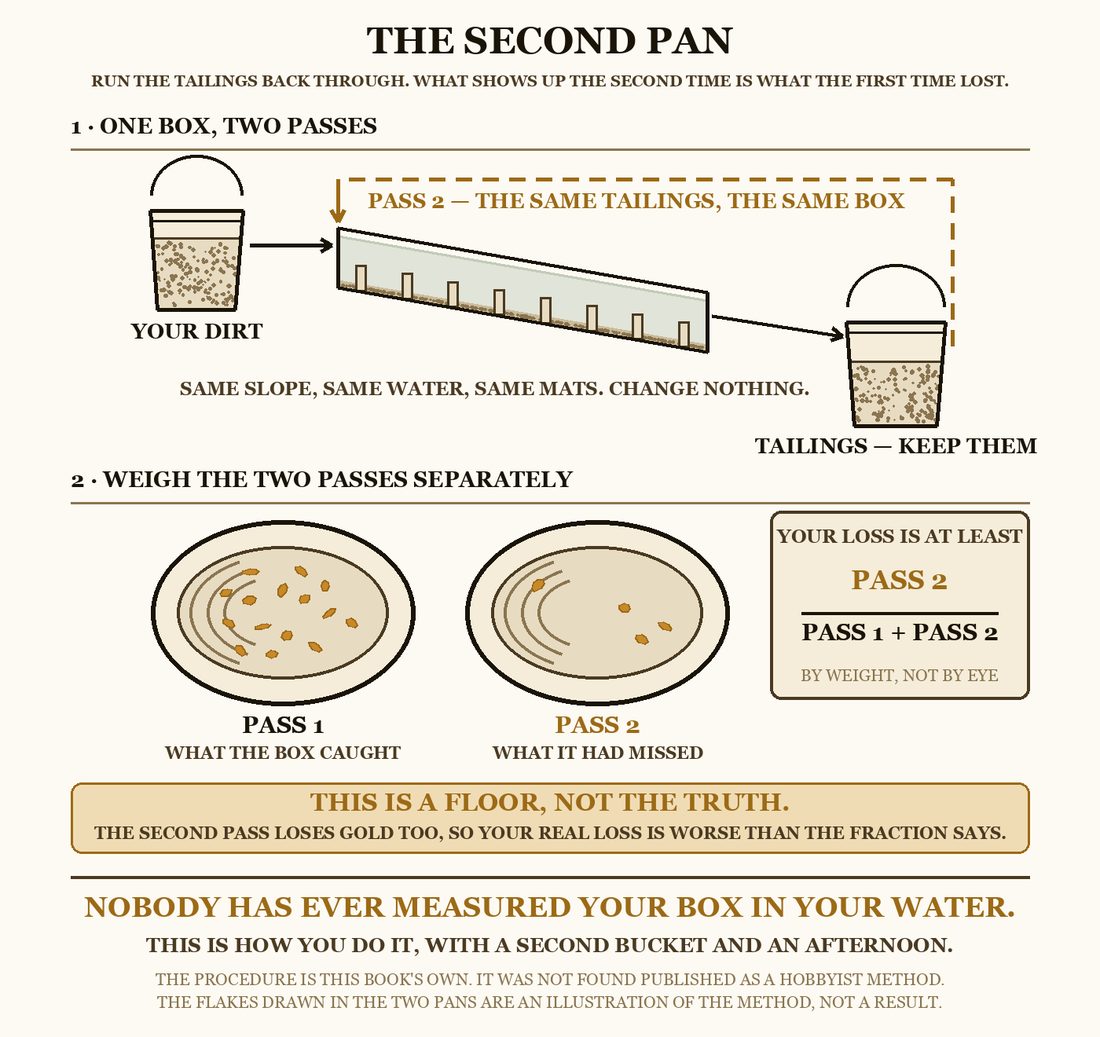
Chapter 3 — The Second Pan: Measuring What Your Own Setup Is Losing, for Nothing. Run a bucket the way you normally run it. Catch the tailings in a second bucket. Run the tailings again. What shows up on the second pass is gold the first pass threw away, and the fraction is printed: f = g₂ ÷ (g₁ + g₂). Then the honest limit, on the same page rather than in a footnote: it is a floor, not the truth, because the second pass loses gold too — and the chapter shows you how to put a floor under the floor. It costs an afternoon and nothing else, and it ends with exactly what your number is and is not allowed to decide about a purchase.
03
Imperative Is Their Word
The cleanup machine is on the bench and the concentrates still will not come apart. Somewhere there is a stack of screens you did not buy, because they looked like an accessory to the machine rather than part of it.
The people who make the Blue Bowl wrote down what it needs, in their own instructions: "it is imperative to prescreen the concentrates using a 30-mesh sieve", nested at 30, 50, 100. The water level the machine runs at changes depending on which screen you used. Imperative is their word. Nobody had to supply it.
Chapter 4 — Classify or Buy: The $8 Sieve Against the $400 Concentrator. Why screening is the lever and the machine is not — an unclassified feed physically cannot be sorted by any machine at any price, because size competes directly with density in settling. Individual sieves in stock on 26 August 2026: $7.95 to $24.95. Machines bought for the same job that day: $385.00 to $460.00, larger models to $999.00. Both ends printed with their vendors so you can rebuild the division any way you like. And the same bowl listed at $84.95, $92.95 and $129.95 by three retailers on one day — a $45.00 difference for the price of opening three tabs.
04
The Bag on the Kitchen Table
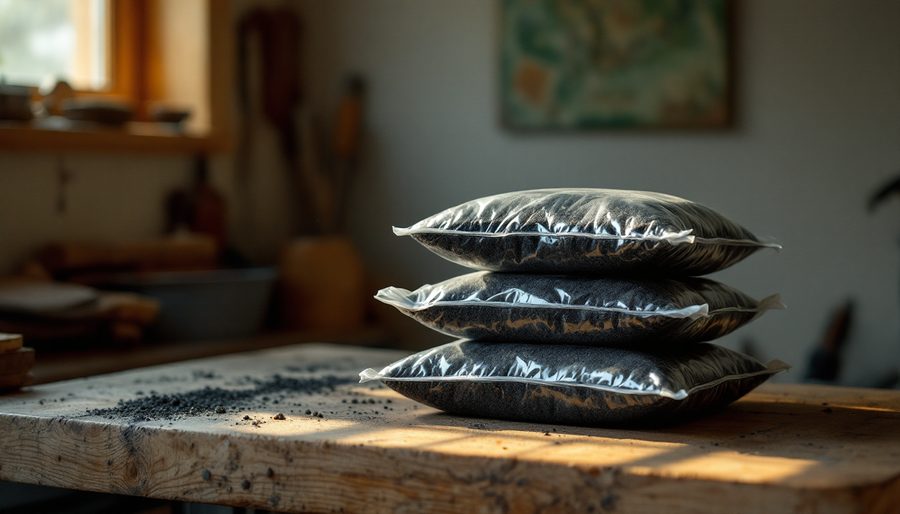
Saturday morning, a tub of water, a pan, and a bag somebody in another state dug, screened, bagged and shipped. There is nothing ridiculous about buying it — for a lot of people it is the only panning that happens between November and April.
You paid the price on the page. You have no idea what you paid per gram, because nobody in this hobby has ever put it that way in public.
Chapter 9 — The Bag: How to Price Paydirt Before You Click Buy. One division, built entirely from the two numbers the seller publishes himself, which is what makes it unanswerable and why it accuses nobody. Twenty bags from seven sellers, read on one day, sorted by dollars per gram: $140.59 to $289.90. On the same page, printed with the list because otherwise the list misleads: they are published as minimums, so every figure is a ceiling and not the amount; two sellers publish added gold rather than gold content; two publish random bonus bags that push the average the other way; and no figure includes shipping or the fineness correction. Plus the one purchase rule the community arrived at on its own — a minimum stated in writing, in grams, on the page, before you pay.
05
The One Purchase You Cannot Undo
A pan you regret costs you the price of a pan. A screen you did not need goes in the shed with the other screens and hurts nobody. The detector is the one where a wrong answer runs into three and four figures — and it is the easiest of all of them to decide standing up in a shop, against a budget that was set somewhere else.
On 26 August 2026 the manufacturers priced their own entry shelf from $369.00 at 19 kHz to $899.00 at 45 kHz — and the $679.99 machine runs at 48 kHz. The costlier machine carries the lower number. Frequency does not climb with price, and two makers' own pages say so on the same day.
Chapter 11 — The Detector Decision That Cannot Be Undone. The comparison built only on the one specification manufacturers publish about their own machines, and the exact price step where it stops describing anything at all: a $6,999.00 pulse-induction machine publishes no operating frequency, because it does not have one. Then the two model names that each hide a price range — 19 percent inside one and 24 percent inside the other, and in both cases the thing moving it is a coil — and the question that has to be answered before any of this is worth running — what size gold is in the ground you will be standing on seventy-five percent of the time. That answer costs a conversation, not money.
06
Legal to Own, and You Still Cannot Switch It On
The machine ships. It arrives. It was entirely legal to buy. And then somebody in the club mentions a section number for the water you were going to run it in.
One catalog, one morning: a non-motorized stream sluice at $124.95, a high-banker at $2,295.00. The gap is $2,170.05 — and the feature you are paying it for is the exact feature California, Washington and Oregon each draw their line at. The cheaper machine is the one that carries no question.
Chapter 10 — The Machine You Can Legally Buy and Cannot Legally Use. The federal casual-use definition at 43 CFR 3809.5 read for what it functionally is, which is a shopping list: hand panning and non-motorized sluicing inside it, mechanized earth-moving equipment outside it. California Fish and Game Code § 5653(e), where possession within a hundred yards of closed waters is the offense, alongside § 5653(g), which states in the legislature's own words that none of it restricts non-motorized recreational mining including panning for gold. Washington, which hands you limits as numbers you can check with a tape measure. It is not a summary of anybody's law and it says so. What it is, is a twenty-minute procedure for checking your own state, this season, against the agency that would write you the citation.
Six chapters, six purchases, and not one of them decided with an adjective.
Secure Stripe checkout · Instant PDF delivery to your email · Sixty-day refund, and you keep the PDF
What It Is. And, More Usefully, What It Is Not.
What it is
- A test notebook, not a buying guide and not a review. Every claim is a dated price, a manufacturer's own published specification, arithmetic you can redo, or a regulation cited by section.
- Thirteen chapters, each one opening with what this chapter decides, in two sentences, before you read a word of it.
- Every chapter carries the same five blocks: the named entries · Checked on, listing every price, spec and regulation in that chapter with its source and date · Different state, different water, the box that says whose ground you are on and what changes across a state line · How this fails, naming the way the chapter's own advice goes wrong · and Run it yourself, the reproducible test for the chapter's central claim.
- Appendix A — Check Me: every source by name, with the day it was checked and how to reach it for nothing, followed by the printed list of what could not be verified at all.
- Appendix B — The Arithmetic Sheets: every division in the book on a page of its own with the formula above it and a blank line for yours.
What it is not
- It does not tell you where gold is. No coordinates, no districts, no counties, no directions, no map, no creek. Where states appear they appear as jurisdictions whose rules differ, never as destinations. This book stops at the tailgate and the truck.
- It does not promise you a find. There is no sentence in it that says you will recover more gold, and no story of anybody getting rich.
- It does not put a dollar figure on what you will save in a year. That number does not exist. It depends entirely on what you were about to buy, and anybody quoting you an average is quoting you the middle of a gap they invented.
- It does not tell you what percentage of your fine gold you are losing. It cannot. It hands you the free procedure that produces your own figure instead, with the honest limit printed next to it.
- It does not accuse any company of anything, and it does not rank brands. No independent comparative trial between these products was found in the accessible record, and inventing one would make this book exactly the thing it was written against.
- And nobody here claims to have stood in your creek. No day in the water, no home river, no jar on the shelf belonging to the author, no test run and reported back to you as a result.
One more boundary, because the shelf is confusing on this point. The word recovery in this book always means getting gold out of material you moved yourself, at the water. It never means refining, smelting, assaying or pulling gold out of electronic scrap.
Secure Stripe checkout · Instant PDF delivery to your email · Sixty-day refund, and you keep the PDF
Thirteen Chapters. 384 Pages. Every Figure Dated.
The full table of contents, published before you pay. Titles as they appear in the file.
- What Your Gram Is Worth, and What Your Hour Costs The two denominators every other purchase in the book gets divided by, with the purity left blank for you to fill in.
- Gold or Not Gold — The Bench Tests Under Two Dollars, and Exactly Where Each One Stops The whole bench protocol, including the ten-second calibration that tells you whether your own tile is lying, and the two walls where it stops.
- The Second Pan — Measuring What Your Own Setup Is Losing, for Nothing The free procedure that turns an argument nobody can win into a number with your name on it, and the honest limit on that number.
- Classify or Buy: The $8 Sieve Against the $400 Concentrator What your cleanup device's own instruction sheet says it needs, and what that condition costs against the price of the device.
- Black Sand Is Not Your Excuse: The Concentration Criterion, the Bucket in Your Garage, and What One Flake Is Actually Worth How many grams a machine has to newly recover before it has paid for itself, and what the bucket behind the garage door is worth hauling.
- Floating Gold: What a Drop of Dish Soap Actually Does, and What the Branded Bottle Does Differently The chapter where the answer is that both products work and work identically, and the half of the mechanism the advice always leaves out.
- Pans, Riffles and Mats: The Five Things That Physically Differ, and the Comparison Nobody Has Ever Published Which of the five variables you are paying for when one costs twelve times another, and how to settle the mat argument in your own water.
- The Sluice Numbers the Manufacturers Publish and Almost Nobody Uses The published operating numbers you can check with a steel rule, and the six corrections strangers make in public under every homemade-sluice video.
- The Bag: How to Price Paydirt Before You Click Buy The seller's own two published numbers turned into one figure, before you type a card number.
- The Machine You Can Legally Buy and Cannot Legally Use The one feature on a spec sheet that moves a purchase from no paperwork into paperwork, and how to check your own state in twenty minutes.
- The Detector Decision That Cannot Be Undone The one specification manufacturers publish about their own machines, and the exact price step where comparing on it stops meaning anything.
- Mercury, Acid and Cold Water — The Three Places Where Cheap Stops Being Smart The chapter that proves this is not an argument that everything cheap is better.
- The Buying Rules: Falsifiable Tests to Apply Before You Spend Anything The whole book collapsed into rules you can check in ten seconds, each one carrying the chapter and the number behind it.
Chapter 2 is the free bench-test file reprinted essentially whole rather than summarized. If you already have that file, the book says so on the chapter's first page, names the half-page that is new, and tells you to skip to Chapter 3. Nobody should have to buy the same procedure twice.
Secure Stripe checkout · Instant PDF delivery to your email · Sixty-day refund, and you keep the PDF
Bundled free · in the same PDF
The Receipt Log: One Season, Written Down, and the Two Numbers It Gives Back.
A season-long ledger with its own cover, bound into the same file as the book. The Gear Ledger: what you have spent, ever, on all of it. The Trip Sheet: one row per outing — the hours, the fuel, what came home, the gold price on the day. The Season Close: the two divisions at the end.
What comes out is your cost per hour and your cost per gram. Not a national average, not a figure from a magazine. Yours.
It is bundled rather than sold because the community asked this question in a twenty-reply thread and answered it with no arithmetic at all, and charging a second time for the arithmetic would be the exact behavior this book exists to complain about.
The log also prints its own failure mode — How This Log Fails — and a page on what those two numbers are not, which is the part every spending tracker leaves out.
Secure Stripe checkout · Instant PDF delivery to your email · Sixty-day refund, and you keep the PDF
The Book, the Log and the Sheets. One File. $27.
| What you get | What the closest comparable object costs on the shelf today |
|---|---|
| The Second Pan — 13 chapters, 384 pages | $29 — the respected reference of this genre, a 362-page book, lists at $39.95 and sells at $34.95; the community's own stated ballpark for a book in this hobby is thirty dollars. (Both checked 26 August 2026.) |
| The Receipt Log — season-long ledger, own cover, bundled in the same file | $12 — no published price. We looked for a comparable object and could not find one: searches for instructional prospecting downloads on the two large digital marketplaces on 26 August 2026 returned nothing in this hobby at all. (That is our own valuation of the piece, not a figure off anybody's shelf, and it is labelled that way because everything else on this page carries a vendor.) |
| Appendix B — The Arithmetic Sheets — every division in the book on a page of its own, formula above it, blank line for yours | $5 — our own valuation again, on the same footing and for the same reason. |
| Comparable total | $46 |
| This file, today | $27 |
That $46 is not a struck-through retail price and this book is not on sale. Nothing here was ever offered at $46. The $29 is what the nearest comparable object costs on the shelf today, with the day it was checked. The other two are our own valuation and they say so, because a book that spends 384 pages telling you to distrust a number without a receipt is not going to open with one.
The twenty bags priced in Chapter 9 ran from $28.99 to $745.00, and the gram inside them from $140.59 to $289.90 — better than two to one, on one day, in one hobby. A $200 purchase you decide not to make is $200. This file is $27. That division is yours to do, and doing it yourself is the entire habit the book is trying to hand you.
Secure Stripe checkout · Instant PDF delivery to your email · Sixty-day refund, and you keep the PDF
The Run It Again Guarantee
Read the book. Run one procedure — the second bucket, the tile, the paydirt division, the twenty minutes on your own state's rules. Whichever one is yours.
If you come out the other side without a number you did not have before, the refund stands for sixty days from your purchase and you keep the PDF. Reply to the receipt email and say so. No forms, no questions.
You keep the file because a PDF cannot be taken back and pretending otherwise would be theater. At $27 the arithmetic on that is not complicated, and a refund is cheaper for both of us than a man who feels sold to.
Secure Stripe checkout · Instant PDF delivery to your email · Sixty-day refund, and you keep the PDF
Readers Who Ran the Procedures
Free · One PDF · 28 pages
Not ready for the book? Settle the jar first.
Gold or Not Gold is the bench test that ends the doubt about the vial on your shelf tonight, on material you already have — starting with the ten-second calibration that tells you whether your own tile is lying to you. Free, and it stops where it stops.
Free. One PDF, 28 pages. No card, and you can leave the list from any email in one click. You will also get three emails over the next nine days about what the book does.
Eight Questions, Answered Before You Pay
1 · What exactly do I get, and is any of it physical?
Digital only, and it is one file. A single PDF — 384 pages, thirteen chapters — delivered to your email within a minute or two of paying. The Receipt Log workbook is bound into that same PDF with its own cover at no extra charge, along with Appendix A, which lists every source with the day it was checked, and Appendix B, the arithmetic sheets. Two named pieces, one file in your inbox. It is yours to keep and to reread every season.
2 · Does it tell me where to find gold, or promise I will find more?
No, and no. This book does not tell you where gold is. It is not a site guide, it contains no coordinates, no districts and no directions, and nobody here claims to have stood in your creek. It is about the equipment you buy, what it costs, what its own manufacturer says it needs in order to work, and how to measure what your own setup is actually doing. Where to dig is a different question and it is not this one. If that is what you came for, do not buy this — you will want your money back and you will be right.
3 · I have been doing this for forty years. Is there anything in here for me?
Probably, and here is how to decide in ten seconds rather than after you have paid. If you have already re-run a full day of your own tailings and know your own loss fraction, already priced your last season by the hour and by the gram, already read the instruction sheet of every machine you own, and already checked this season's rules with the agency that manages the water you stand in — then you are the one man this book has little to offer, and you should keep your $27.
If you have not done all four, the gap is not experience. It is that nobody ever printed the procedures. Plenty of men with forty years in have never seen the streak test written down as a protocol, and that is not a failure of judgment. It is a failure of the information they were handed.
4 · How much will this save me?
This book refuses to answer that, and the refusal is the reason to trust the rest of it. There is no aggregate savings figure anywhere in it — not a dollar amount, not a percentage, not "the average prospector wastes X". That number does not exist, because it depends entirely on what you personally were about to buy, and anybody quoting you an average is quoting you the middle of a gap they invented.
What it gives you instead is savings one decision at a time, each with its own published price and the day that price was checked: what a screen costs against what a machine costs, what the same bowl was listed at by three retailers on one morning, what a bag of paydirt works out to per gram of the seller's own published grams. You do the division on the ones that apply to you. That is the whole method, and it is also the habit the book is trying to leave you with.
5 · How do you compare products? Do you rank brands?
How products are compared in this book. Every comparison here rests on one of four things and nothing else: a price the seller published, with the day we checked it; a specification the manufacturer published about their own product; physics or arithmetic you can reproduce yourself, with the method printed; or an action documented by an official agency, cited by section and date. This book does not accuse any company of anything, does not rank brands, and does not claim that one commercial model recovers more gold than another — because no independent comparative test of these products exists that we could find, and inventing one would make this book exactly what it was written against. Where a product is named, it is named because its published price or its published specification is the evidence. Prices move. Check them.
6 · Is any of this legal where I live?
That is the right question and it is the one Chapter 10 is built to help you answer for yourself, because nobody can answer it for you.
Prospecting rules in the United States are set by federal agency, by state, by individual waterway and sometimes by county, and they are revised without notice. Washington publishes riffle-area and channel-width limits as numbers you can check with a tape measure. Idaho requires a Letter Permit for small-scale mining below the ordinary high water mark — with a motor, or without one once a sluice moves more than a quarter of a cubic yard an hour — and a separate temporary water-use approval if you pump stream water to a powered sluice or high-banker sitting above that line. Oregon exempts hand panning from its wastewater permit requirement, covers non-motorised in-water equipment under a general permit with no application and no fee, and puts a high-banker under a different permit altogether — one that does not apply below the ordinary high water level. Those three are not a summary of American law; they are three examples of how far apart neighbouring states can be. Check the state you will be standing in, this season, with the agency that would issue you a citation. "It was legal last year in the next state over" is how people get cited.
7 · Do you tell me what my gold is worth?
This book prices gold as metal — at a stated spot quote on a stated date, with the correction that placer gold is not pure — so that you can compare what you paid against what you got. It does not appraise specimens, it does not tell you what a nugget is worth to a collector, and it is not advice about buying or holding gold as an investment. If you want a specimen valued, take it to a qualified buyer or appraiser.
8 · The videos are free and there are thousands of them. What does a paid file add?
Keep watching them. The videos are not the problem and the people making them are not the problem either — a good deal of what is in this book started as a question somebody asked in a comment section, and one of the sharpest purchase rules in Chapter 13 was arrived at by that community before anybody printed a table.
Here is the narrower thing this file is for. Almost everybody who holds this data has a reason not to write it down next to the cheap substitute: the blogs that run these comparisons are paid on affiliate commission, the shops sell the hardware, the association sells the kit, and the manufacturers publish specifications about their own products. That is not an accusation, it is just how the money is arranged. A file with no store behind it, no affiliate link and no sponsor is not smarter than anyone. It is simply the one that loses nothing by printing the price of the two-dollar answer beside the price of the four-hundred-dollar one.
And a video is watched once, on a phone, with the numbers undated. This is 384 pages you open at the tailgate, with every price, specification and regulation carrying the day it was checked, a Checked on block at the end of every chapter, and an appendix that lists what could not be verified at all. Bring the arithmetic with you.
Secure Stripe checkout · Instant PDF delivery to your email · Sixty-day refund, and you keep the PDF
Nobody Has Measured Your Box. That Includes Us.
Which is the point. This book does not hand you a percentage, a ranking or a promise. It hands you a second bucket, a tile that costs pennies, a division you can do on a phone at the tailgate, and the date every one of its numbers was checked. What you get out the far end is yours, it was measured rather than argued, and nobody sold it to you.
- 2026 edition — every price, specification and regulation carries the day it was checked, and the revision date is on the title page.
- Thirteen chapters, 384 pages, one PDF — with the Receipt Log workbook bundled in the same file.
- Appendix A prints what could not be verified at all — which is not a thing books in this hobby do.
- No coordinates, no rankings, no promised find, no savings figure — and no author who claims to have stood in your creek.
- Sixty-day refund, and you keep the PDF.
Secure Stripe checkout · Instant PDF delivery to your email